Monday, May 5, 2014

Quadratic Functions

So I was looking at different stuff about parabolas and discovered that reflections from a parabola all land in one spot. When light, or other rays all come in towards a parabola and hit off of the insides, they all reflect to one spot, called the focus. Here's what I mean:
parabola
As I continued researching the focus of a parabola, I learned that this is no coincidence. A parabola can be formed from a focus. You also need a directrix, a straight line. To form the parabola, you draw a whole bunch of points that are each equidistant from the directrix and the focus. Connecting these points will form a parabola.
parabola

However, all of the examples I found of this had the focus that wasn't on the directrix. So I thought about this and realized that a focus on a directrix would just be a point on a line. All of the points equidistant from the focus and directrix would just be on top of the focus. Does this mean that a point is actually a parabola?


Saturday, April 5, 2014

Tessellations

Trevor's blog got me thinking about patterns, and specifically, tessellations. But before I started writing this blog, I knew very little about tessellations. I only knew that they were pretty, so I decided to do some research. Here is what I found:

In a tessellation, all of the shapes must meet around a common vertex. So that means that this:  isn't a tessellation because the shapes don't all meet at one corner.


I also learned that there are four different types of tessellations. There are regular tessellations, made of a congruent, regular shape repeating. There are only three different regular tessellations, the triangle, square, and hexagon. This is because these are the only shapes whose angles are multiples of 360. At the vertex, the angles all add up to 360. 

The next type of tessellation is the semi-regular tessellation. This has the same regular shapes repeating, but there can be more than one shape. There are only 8 of these. 

The next type of tessellation is the nonuniform, periodic tessellation. This has a pattern, but the shapes meeting at the vertices can all be different. There are an infinite number of these tessellations.

The last type of tessellation is the nonuniform, non-periodic tessellation. This tessellation does not have any specific pattern. 

Finally, I looked up images of tessellations. Here are some of my favorites:


Tuesday, February 18, 2014

Pascal's Triange

When I was looking for ideas about Pascal's triangle to write my blog on, the pattern that was most interesting was Sierpinski's triangle. It is formed by coloring odd numbers one color and even numbers another color, like so:
[Pascal]
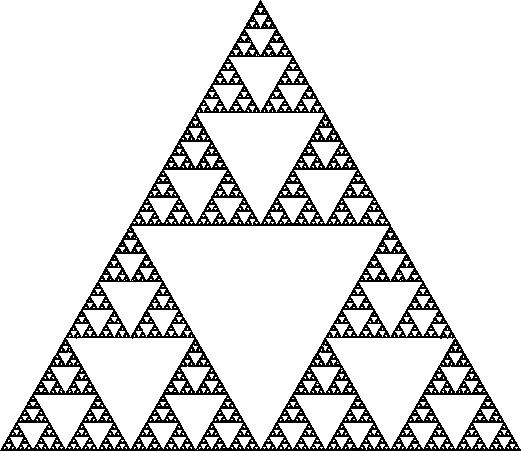
When I saw this pattern, I immediately recognized it as a fractal: a pattern that repeats indefinitely. Here is a picture of Sierpinski's triangle in more detail:
[Sierpinski Triangle]
This pattern would repeat indefinitely because when you add two even numbers or two odd numbers together you get an even number, and when you add an even and an odd number together, you get an odd number. Since you get the numbers of Pascal's triangle by adding the two numbers above, this pattern will repeat.

A few years ago, I was a part of the effort to set the world record for the largest Sierpinski's triangle. Now, I am mindblown by the connection to Pascal's triangle. And in case you want to make one of these yourself, all you have to do is draw a triangle, the connect the midpoints of the triangle. Then continue doing this in each of the three outside triangles that you just formed.

Tuesday, January 14, 2014

HUMOR!


Here are some math comics,  clever pictures, riddles, and lame jokes that I found.

Q: How do you make seven an even number? A: Take the s out!


What kind of tree does a math teacher climb?A Geometry !


Teacher: How much is half of 8Pupil: Up and down or across ?Teacher: What do you mean ?Pupil: Well,up and down makes a 3 or across the middle leaves a 0


Why was 6 afraid of 7? Because 7, 8, 9.