Monday, May 5, 2014

Quadratic Functions

So I was looking at different stuff about parabolas and discovered that reflections from a parabola all land in one spot. When light, or other rays all come in towards a parabola and hit off of the insides, they all reflect to one spot, called the focus. Here's what I mean:
parabola
As I continued researching the focus of a parabola, I learned that this is no coincidence. A parabola can be formed from a focus. You also need a directrix, a straight line. To form the parabola, you draw a whole bunch of points that are each equidistant from the directrix and the focus. Connecting these points will form a parabola.
parabola

However, all of the examples I found of this had the focus that wasn't on the directrix. So I thought about this and realized that a focus on a directrix would just be a point on a line. All of the points equidistant from the focus and directrix would just be on top of the focus. Does this mean that a point is actually a parabola?


Saturday, April 5, 2014

Tessellations

Trevor's blog got me thinking about patterns, and specifically, tessellations. But before I started writing this blog, I knew very little about tessellations. I only knew that they were pretty, so I decided to do some research. Here is what I found:

In a tessellation, all of the shapes must meet around a common vertex. So that means that this:  isn't a tessellation because the shapes don't all meet at one corner.


I also learned that there are four different types of tessellations. There are regular tessellations, made of a congruent, regular shape repeating. There are only three different regular tessellations, the triangle, square, and hexagon. This is because these are the only shapes whose angles are multiples of 360. At the vertex, the angles all add up to 360. 

The next type of tessellation is the semi-regular tessellation. This has the same regular shapes repeating, but there can be more than one shape. There are only 8 of these. 

The next type of tessellation is the nonuniform, periodic tessellation. This has a pattern, but the shapes meeting at the vertices can all be different. There are an infinite number of these tessellations.

The last type of tessellation is the nonuniform, non-periodic tessellation. This tessellation does not have any specific pattern. 

Finally, I looked up images of tessellations. Here are some of my favorites:


Tuesday, February 18, 2014

Pascal's Triange

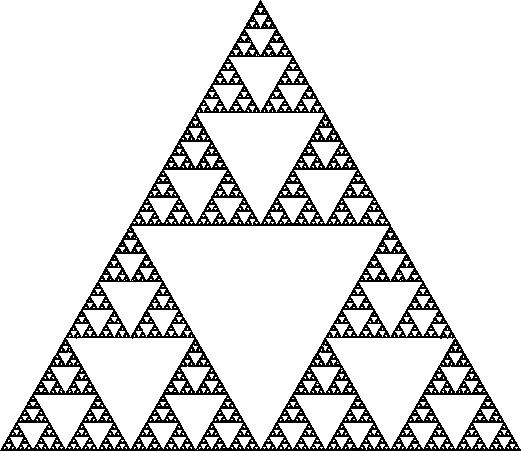
When I was looking for ideas about Pascal's triangle to write my blog on, the pattern that was most interesting was Sierpinski's triangle. It is formed by coloring odd numbers one color and even numbers another color, like so:
[Pascal]
When I saw this pattern, I immediately recognized it as a fractal: a pattern that repeats indefinitely. Here is a picture of Sierpinski's triangle in more detail:
[Sierpinski Triangle]
This pattern would repeat indefinitely because when you add two even numbers or two odd numbers together you get an even number, and when you add an even and an odd number together, you get an odd number. Since you get the numbers of Pascal's triangle by adding the two numbers above, this pattern will repeat.

A few years ago, I was a part of the effort to set the world record for the largest Sierpinski's triangle. Now, I am mindblown by the connection to Pascal's triangle. And in case you want to make one of these yourself, all you have to do is draw a triangle, the connect the midpoints of the triangle. Then continue doing this in each of the three outside triangles that you just formed.

Tuesday, January 14, 2014

HUMOR!


Here are some math comics,  clever pictures, riddles, and lame jokes that I found.

Q: How do you make seven an even number? A: Take the s out!


What kind of tree does a math teacher climb?A Geometry !


Teacher: How much is half of 8Pupil: Up and down or across ?Teacher: What do you mean ?Pupil: Well,up and down makes a 3 or across the middle leaves a 0


Why was 6 afraid of 7? Because 7, 8, 9.


Saturday, November 9, 2013

Human Calculator Skills

I decided to research about Shakuntala Devi. One story that I found in multiple places was about her childhood. Her father was a circus performer and when she was only 3 he discovered her abilities for math. He recruited her to help with his card tricks. I was curious as to how her math skills helped with card tricks so I decided to look into that further. On this website  I discovered that she also had a photographic memory. She memorized the order of the cards in the deck, then was able to guess a card. Also as part of her father's circus, she performed math problems in her head quickly. This was the beginning of her lifelong fame and performances as the "human calculator". 

One other interesting tidbit that I learned was how much Devi saw math in her everyday life. This is expected of a mathematician, but I thought it was interesting to the extent that she saw math in our world. Besides seeing math in flowers and hearing it in birds chirping, she saw it on license plates. This website talks about how she would see a number on a license plate, then play with it. For example, when she saw the number 720 she came up with this: 1 x 2 x 3 x 4 x 5 x 6 equals 720. 

Monday, October 14, 2013

Beauty and Geometry


I think that it is amazing that Tom Zhang had enough patience to solve this problem. He keeps repeating that if you are focused and work hard enough for long enough that you can solve any problem. He keeps repeating that his quiet peaceful personality is what allowed him to work for so long. I think that it takes a certain person to be able to be this focused on math. The person must love math, and must love doing math just to do math. The person must be somebody that is happy to work alone for years. I agree that a person like this is born, not made.

This article made me think that math can be not only a school subject, but a lifestyle. Tom Zhang spent hours a day doing math, and even when he wasn't doing math, he was doing math. He would think about math while doing other things, and when taking a break from his math by taking a walk, he often got new ideas. The peace he found in doing math transferred into his everyday life, and he seemed like a very clam man in the interview.

I think that the main message to take away from this is to find something that you love and emerse yourself in it and to not give up.

Saturday, September 21, 2013

Fractions in the Fast Lane (except it's just fractions)


Every student has to do homework at some point, and every student at some point just wants to be done with their homework. But unlike what I imagine other students do, when I am in a rush to be done with my homework, I actually end up doing extra work. I want to know how much homework I have left, and how long it will take me, so I use math to figure that out. I count the number of pages in my history textbook that I have to read, and add the fractions of the pages. .25 + .5 + 4 pages = 4.75 pages more to read. I figure out how many math problems I have to do, then how many parts there are in each question, and then I can figure out how the fraction of the homework that I have done, and what fraction more I have to do. I also look at how many subjects I have homework to do for a night, and then assuming that I have the same amount of homework in each subject, I figure out what percentage done I am with my total homework.

In addition to fractions, I figure out at what rate I am doing my homework for a certain subject, or I know my typical rate from past assignments, and so then I can figure out about how much homework to expect. For example: if I am reading a page every 2 minutes, and I have 4.5 more pages to read, I can figure out that I'll be working for about nine more minutes (assuming I don't get distracted again doing math to figure out what fraction of my homework I still have to do).

Really, doing this math is a hindrance to my homework, and I end up doing extra math trying to figure out how much math homework I still have to do, but it helps keep my mental math skills sharp.